
Arezzo is a hidden gem nestled among four major regions of Tuscany (Casentino, Valdarno, Valdichiana, and Valtiberina). The town has a long history, dating back to the Etruscan civilization, of which many artifacts have been discovered.
It is home to the oldest university in Tuscany and in Europe. Compared to Florence or Siena, it has a more austere yet extremely noble character. It is the birthplace of Giorgio Vasari and Francesco Petrarca, and the setting for Roberto Benigni’s unforgettable film “Life Is Beautiful.”
How to get to Arezzo from Florence
Arezzo is one of the easiest cities to reach from Florence, thanks to its strategic location on the main railway line and the Autostrada del Sole.
| Mean on transport | Travel time | Details |
| Train | 1h – 1h 20 min | The most convenient option. Numerous Regional and Regional Express trains connect Florence S.M. Novella (or Campo di Marte) to Arezzo. The Regional Express trains are very punctual and run frequently. |
| Car | About 1 hour | Take the A1 highway (Autostrada del Sole) toward Rome. Take the “Arezzo” exit. The city center is a restricted traffic zone (ZTL), but there are plenty of parking lots (e.g., Parcheggio Eden or Parcheggio Pietri; the latter is connected by escalators that lead directly up to the Duomo). |
| Bus | 1h 15 min | Several companies (such as FlixBus) offer connections between Villa Costanza (the Florence tram terminal) and Arezzo. These services run less frequently than the train, but can help you save money if booked in advance. |
A bit of history of a magnificent city:
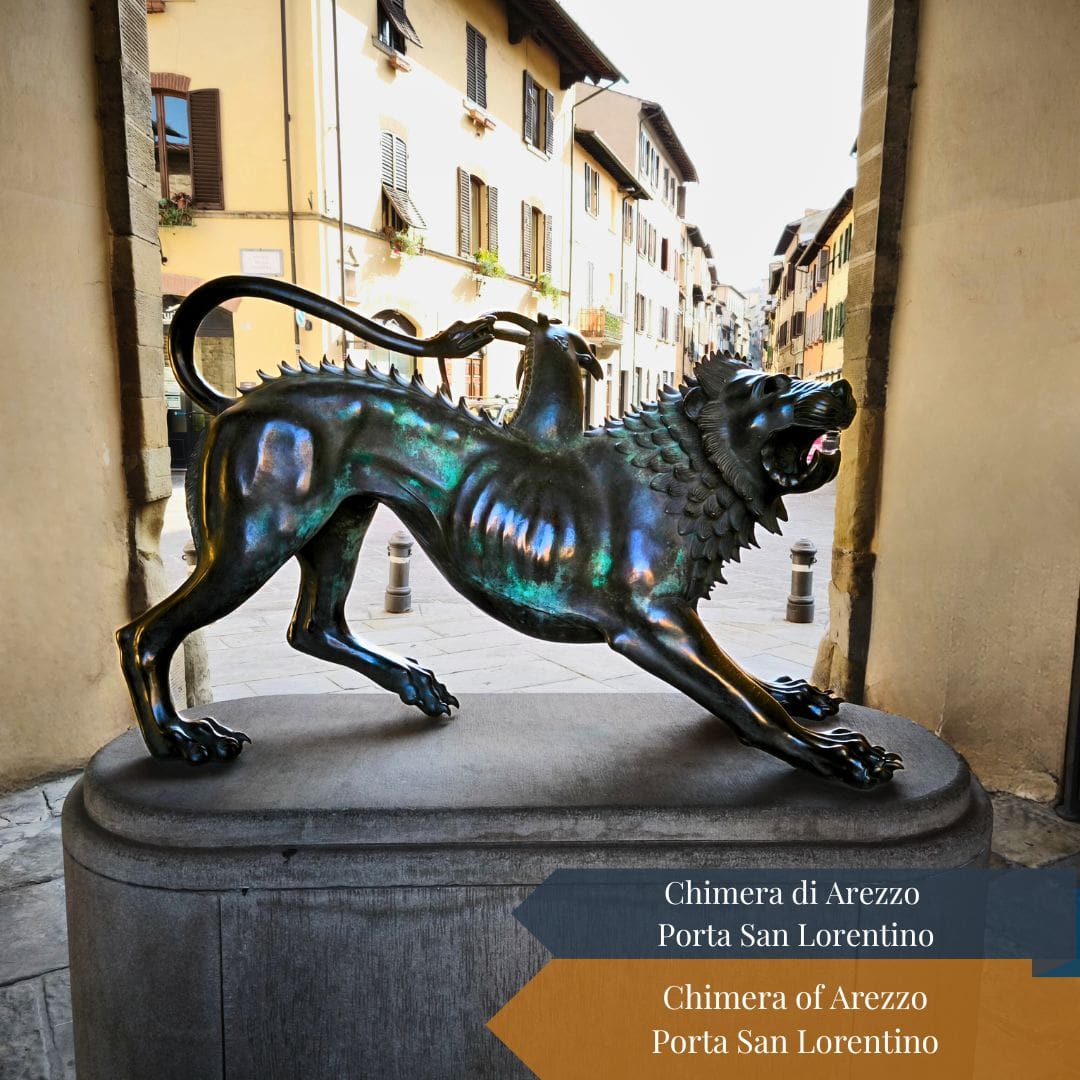
What to see in Arezzo: itinerary and interesting facts
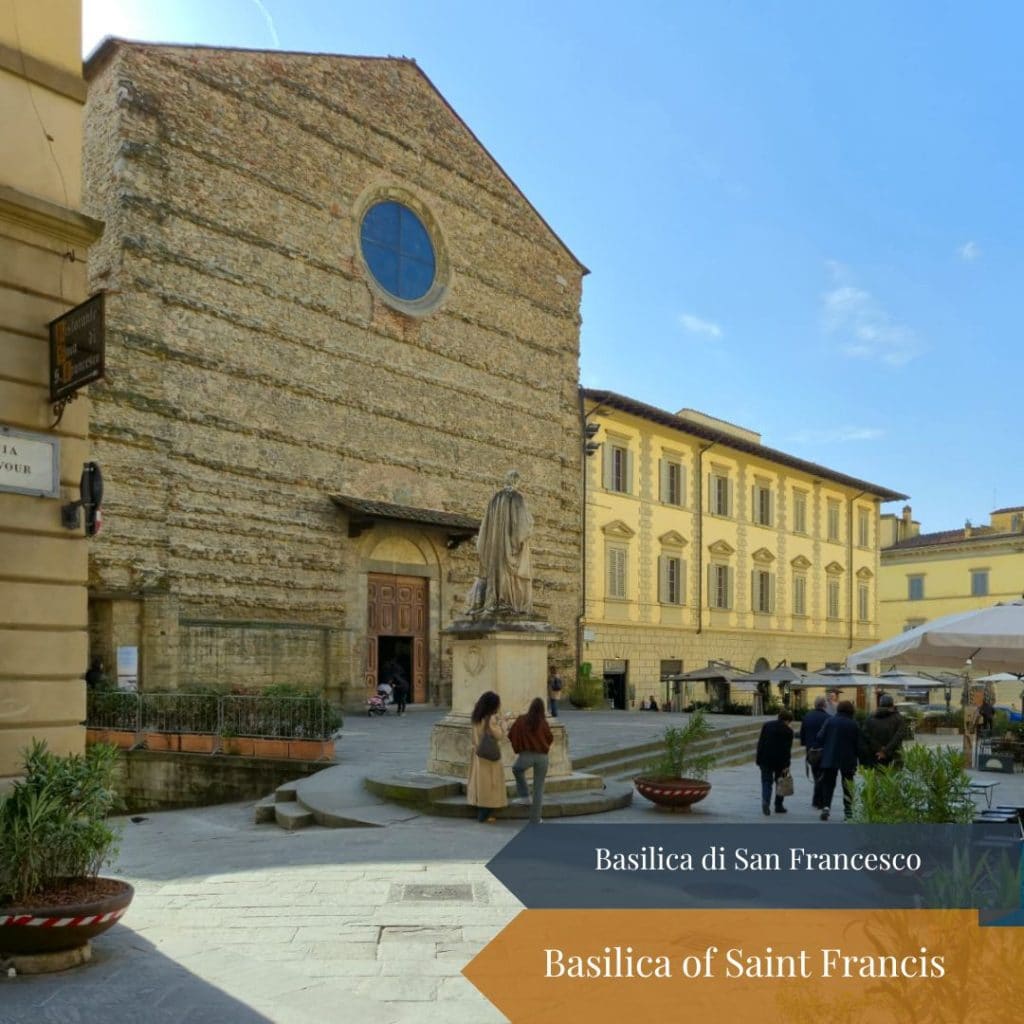
The Basilica of St. Francis:
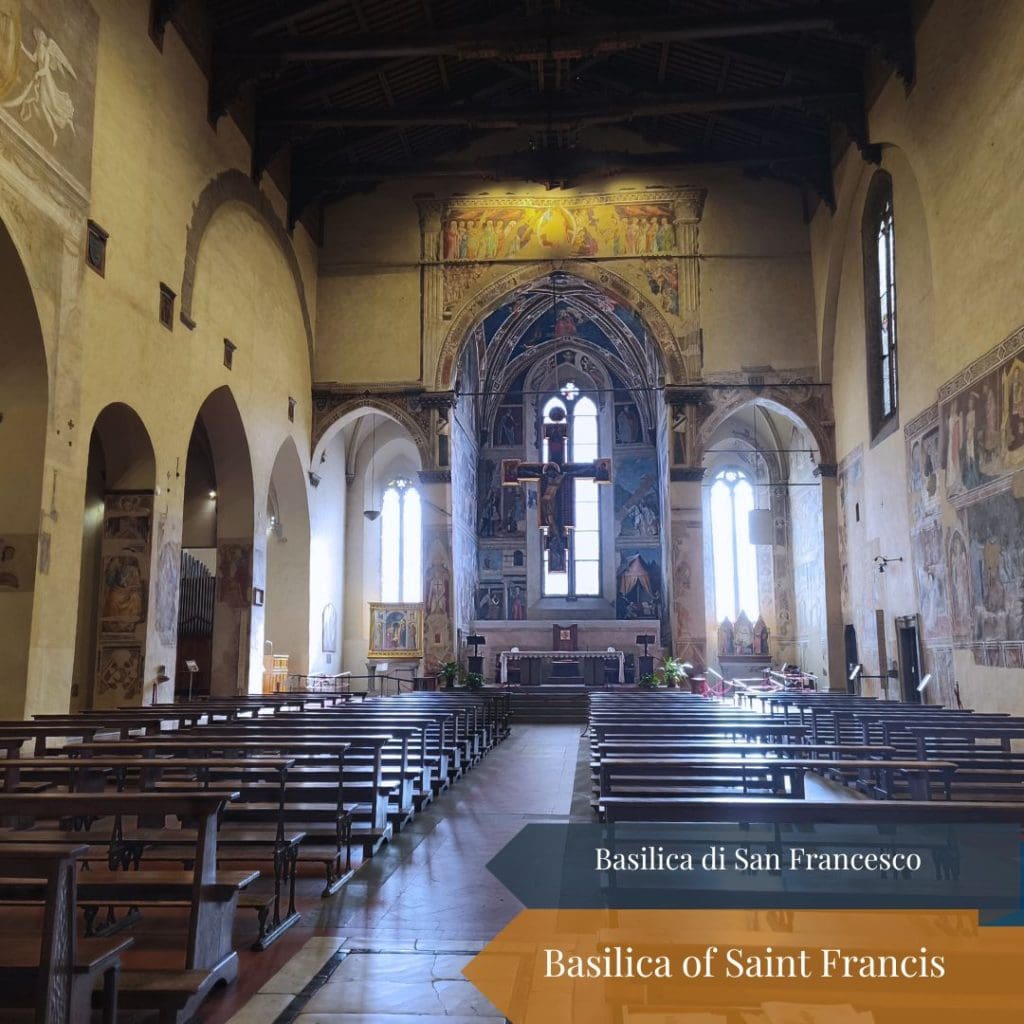
This is a simple church on the outside. In fact, it resembles the Church of San Lorenzo in Florence. Don’t let the “cover” fool you: it hides a priceless treasure.
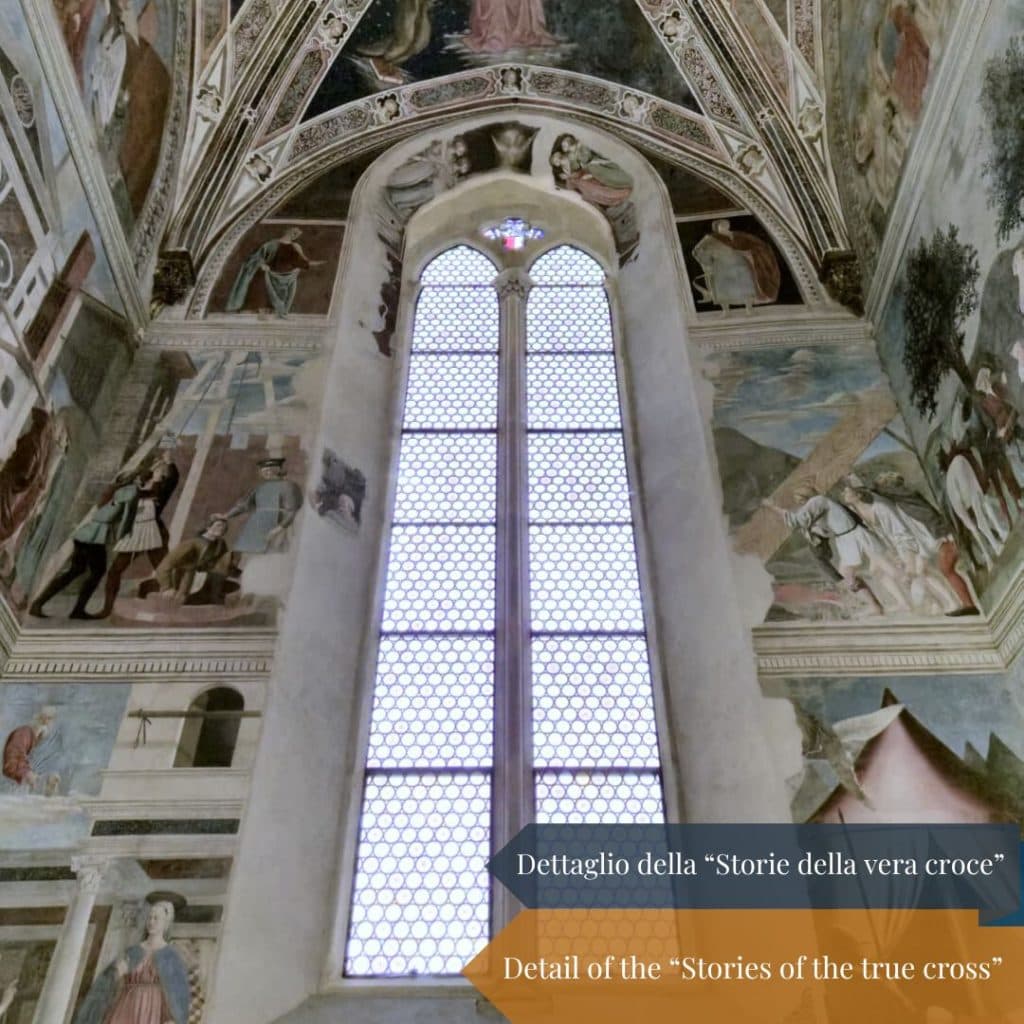
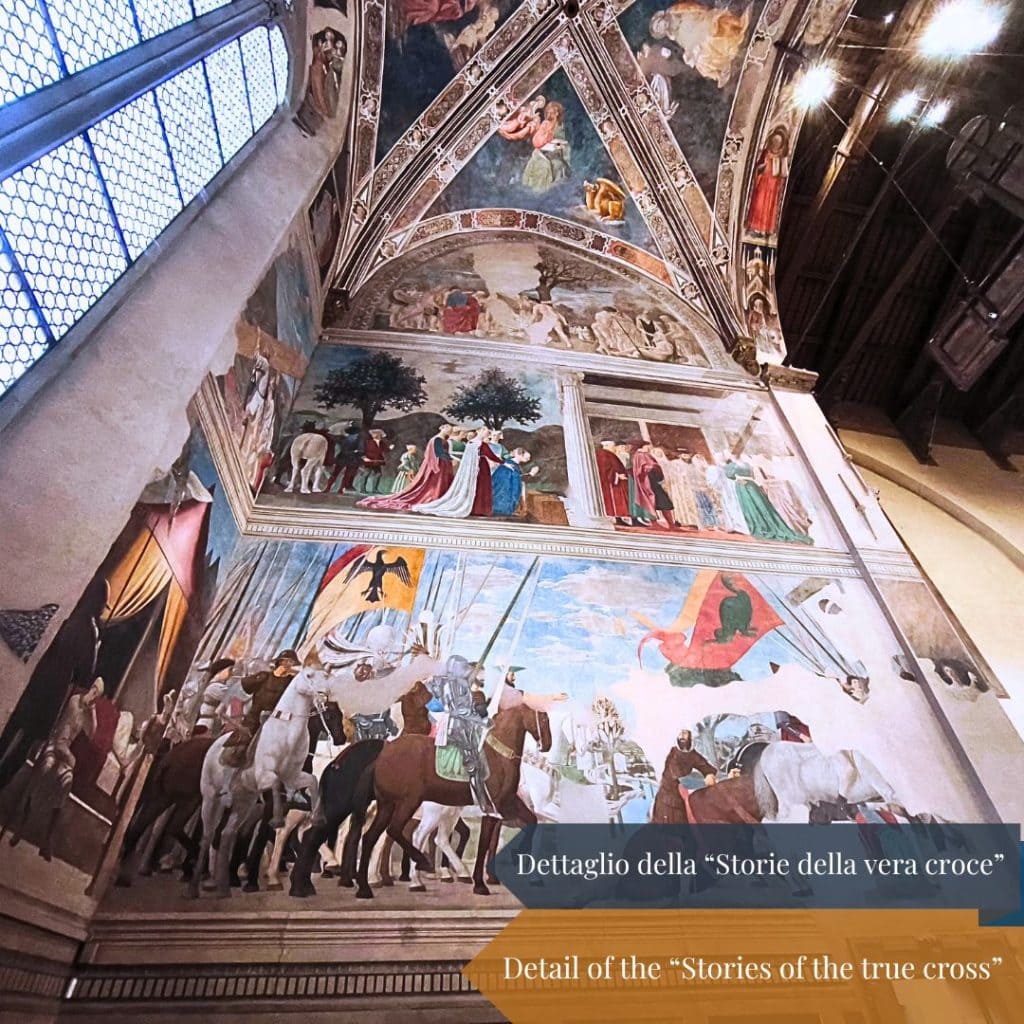
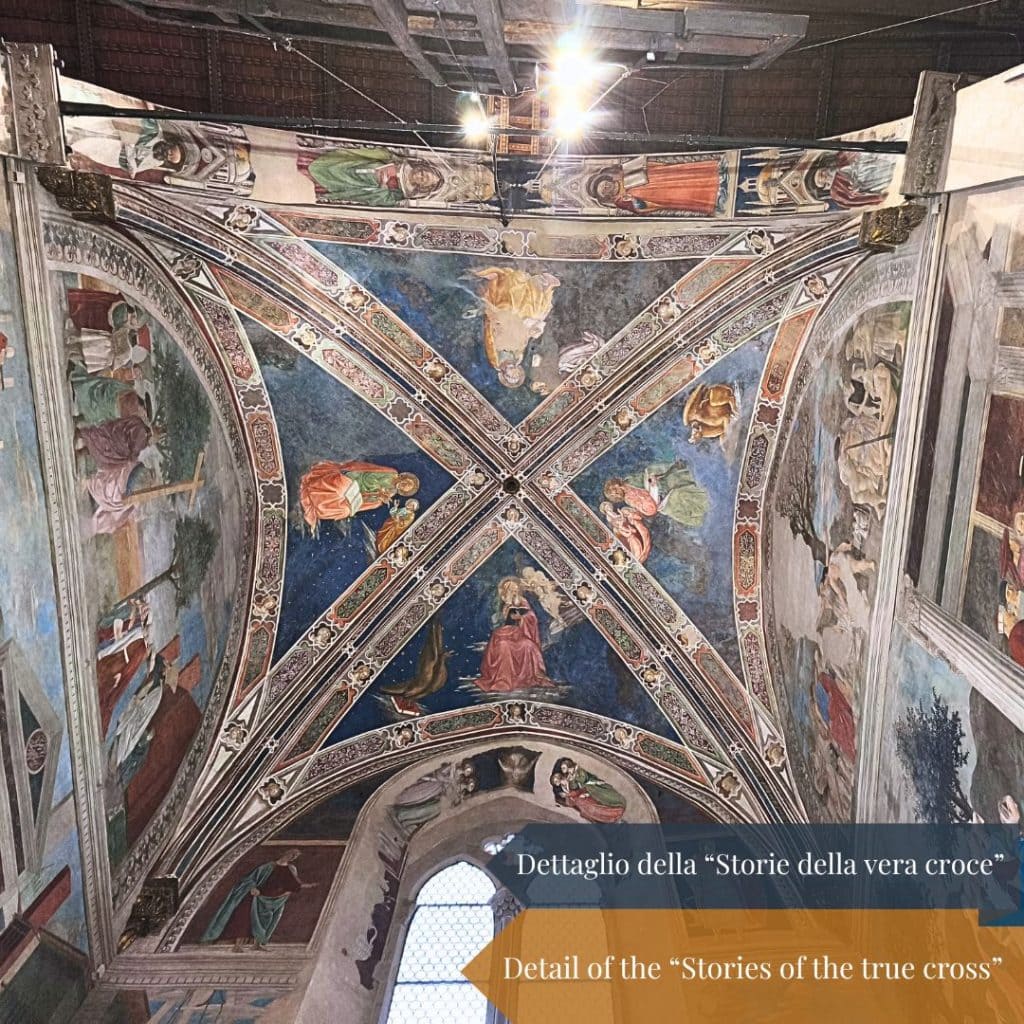
Here, you will find the fresco cycle of the “Legend of the True Cross” by Piero della Francesca, one of the absolute masterpieces of the global Renaissance. These are individual stories, depicted as scenes in a non-linear order, ranging from the Genesis of the Old Testament to approximately 600 AC. All the stories feature the Cross as the protagonist and can be divided into roughly three main parts.
From Adam to the Birth of Jesus
The story begins with Adam, the first man. Now old and reaching the end of his life, he dies at the feet of his desperate children. One of them buries him with a seed from the Tree of Knowledge in his mouth, given to him by the Archangel Michael. The tree grows and remains intact until the time of King Solomon, who has it cut down to build a bridge in his kingdom.
In a subsequent scene, the Queen of Sheba, during her journey to meet Solomon, senses that the wood used for the bridge is sacred. According to her vision, it will lead to the downfall of the Jewish people. When she shares this vision with Solomon, he decides to bury the wood so it can never be found again.
Here, the only scene not directly related to the wood of the Cross is introduced: the Archangel Michael descends from heaven a second time to announce to Mary that she will give birth to the Son of God.
Constantine and his conversion
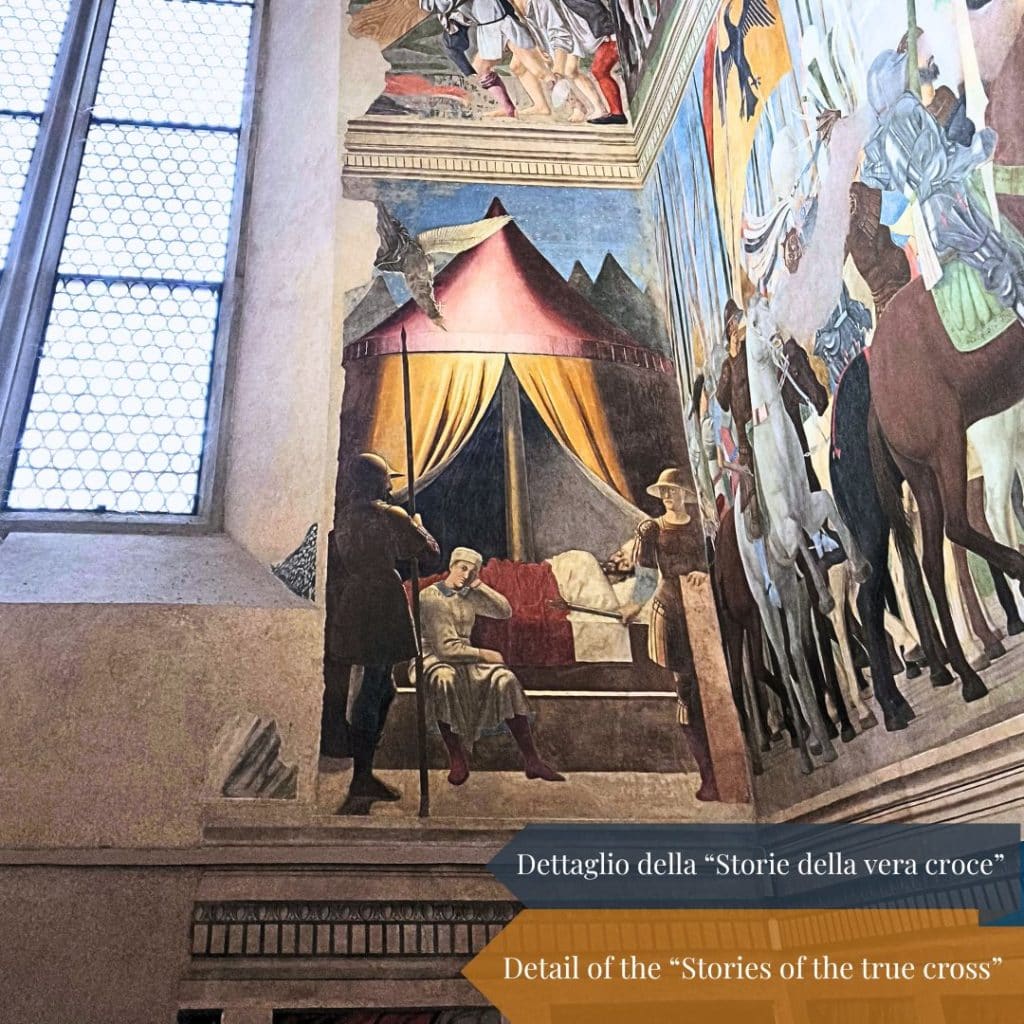
Next is the story of Constantine. Legend has it that an angel appeared to him in a dream the night before the great Battle of the Milvian Bridge against the usurper Maxentius. The angel told him, *“Under this sign, you shall conquer,“* and thus Constantine chose to fight under the sign of the Cross, which guaranteed his victory.
Following this miraculous event, Constantine’s mother, Helena, decided to find the True Cross. She tracked down a man who knew its location and had him thrown into a well until he was ready to talk. The man eventually relented and revealed the burial site. Three crosses were recovered; to identify the miraculous one, Helena had them placed over the body of a deceased youth, who miraculously returned to life when touched by the one True Cross, which was then taken to Jerusalem.
The reconquest by Heraclius
A new despot, the Persian King Chosroes II, conquers Jerusalem and steals the relic of the True Cross. He demands to be worshipped as a god, keeping the sacred relic by his side. The Christians go to war and defeat Chosroes under the command of the Byzantine Emperor Heraclius during the Battle of Nineveh. The Cross is then returned to Jerusalem by Heraclius in a pilgrimage made barefoot, carrying the Cross on his shoulders just as Jesus did. The faithful of Jerusalem welcome his arrival and kneel before the sacred relic.
Curiosities and Hidden Meanings
Perspective and geometry: Piero della Francesca was obsessed with perspective; in the scenes featuring King Solomon and the Queen of Sheba, he applied the rule of the Golden Ratio to achieve perfect proportions. In these frescoes, you will also find one of the first “night scenes” in art history (The Dream of Constantine).
Alchemy: There is a hidden meaning behind the symbolism of the entire work: Alchemy. The study of this subject and the search for the legendary “Philosopher’s Stone” were very popular among the wealthy classes. In fact, the recurring colors of black (nigredo), white (albedo), and red (rubedo) refer to the necessary phases for the creation of the stone.
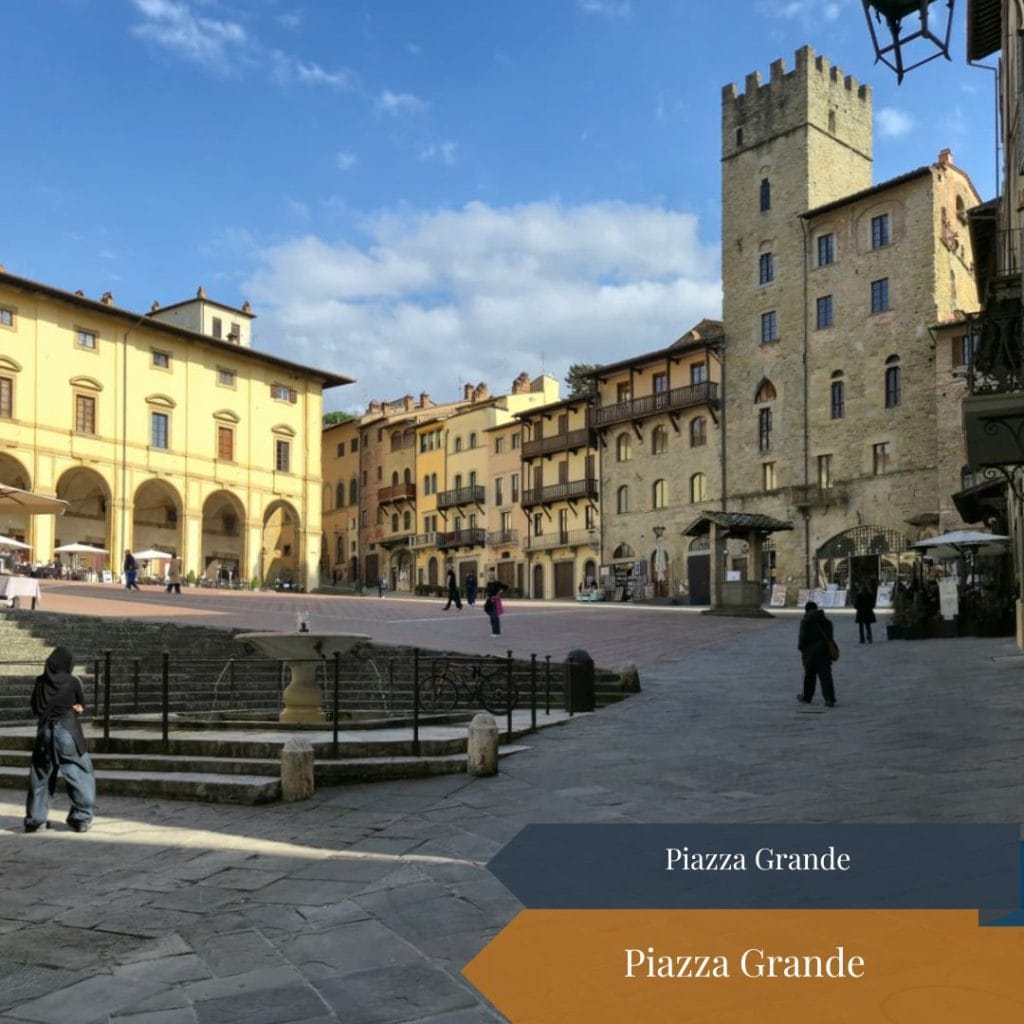
Piazza Grande (or Vasari Square):
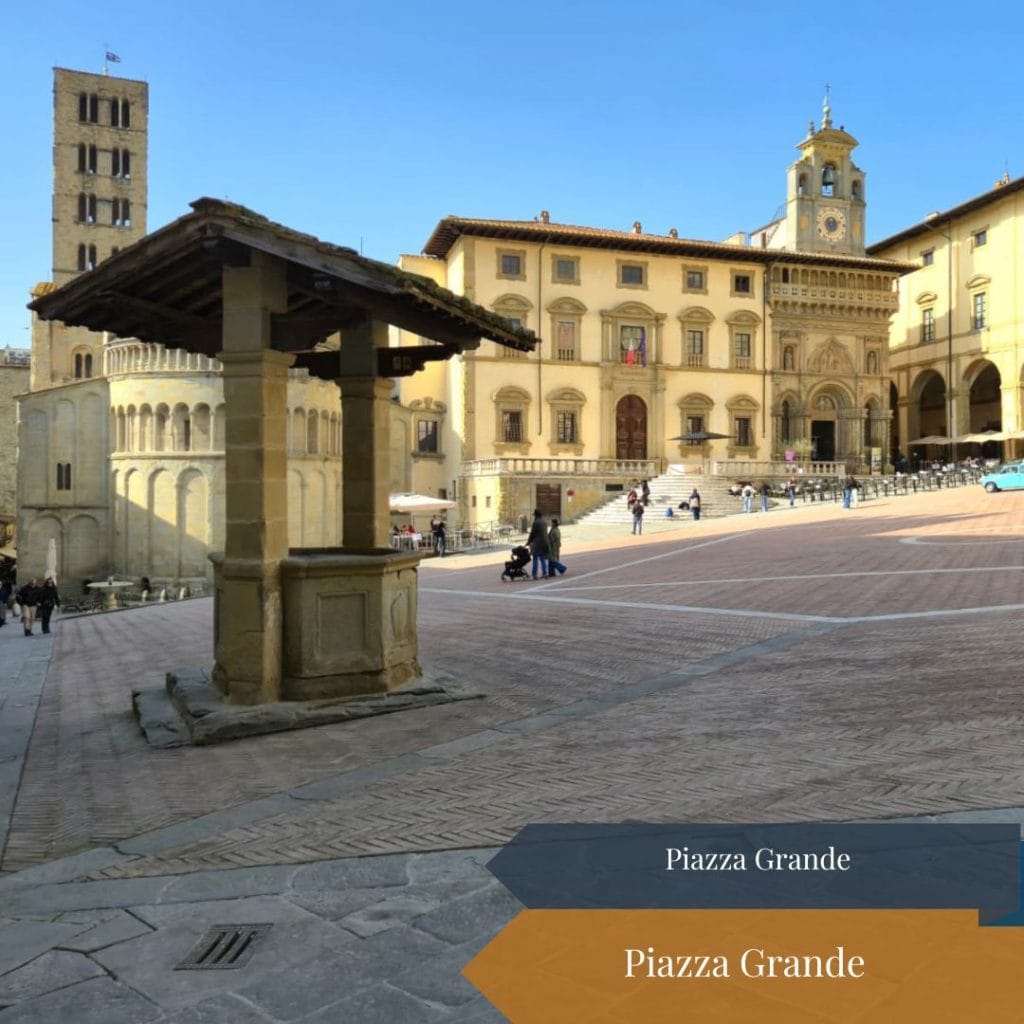
It is one of the most unique squares in Italy due to its trapezoidal shape and its steep slope (which originally served to drain rainwater). It already existed in the Middle Ages, serving first as a marketplace and later as a square for the public shaming of debtors. In 1384, the Florentines conquered the city, halting its political power and expansion.
Here is also the Palazzo della Fraternita dei Laici, which suffered from a lack of independence throughout its entire construction. The building was started in 1375 and, amidst various interruptions in the work, it was finally completed with the addition of the astronomical clock in 1552. The result is a heterogeneous building that showcases three distinct architectural styles (Gothic, Renaissance, and 16th-century).
Until 1560, the square looked very different. It housed the Palazzo del Popolo, the Palazzo del Comune, and other buildings to the north that were demolished by order of Cosimo I de’ Medici. He commissioned Vasari to redesign the space so it could serve as a political center for gatherings and other public events.
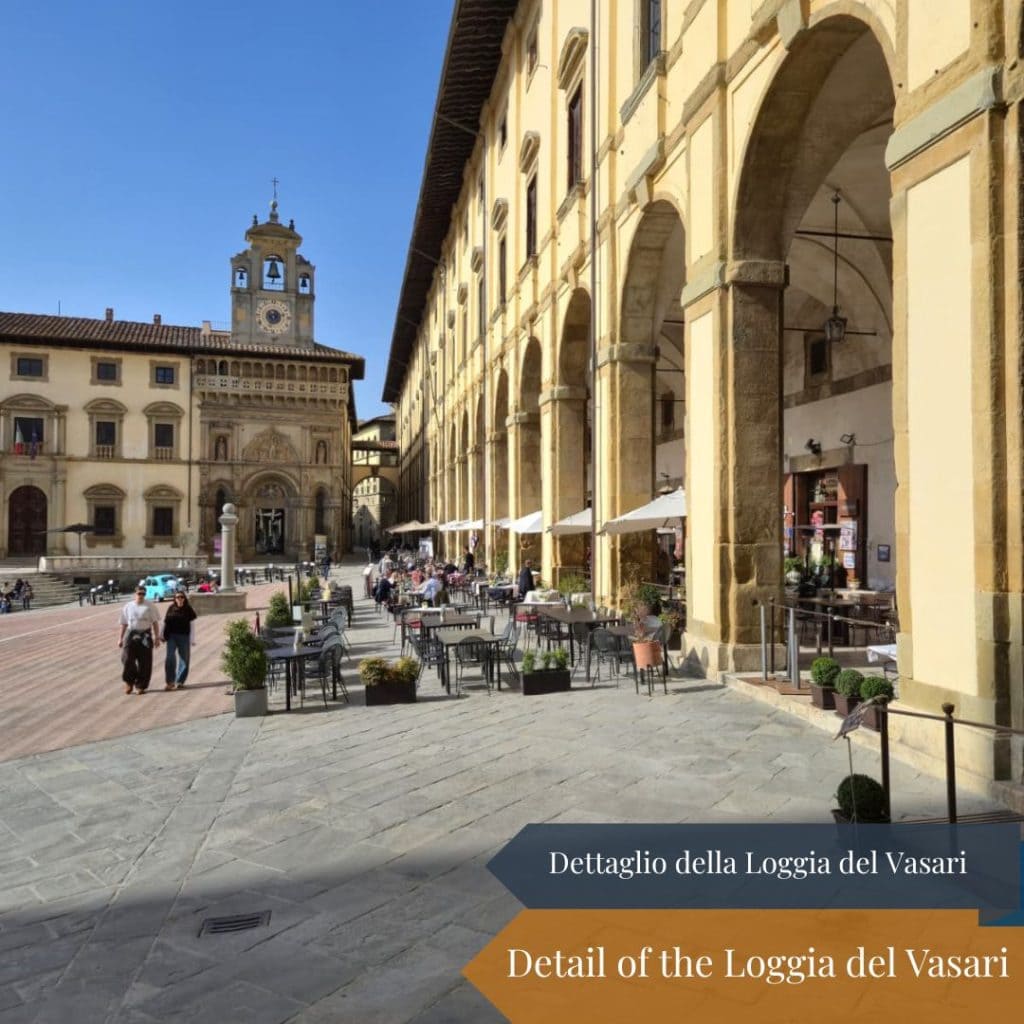
Even today, you can find the Logge del Vasari here. Giorgio Vasari designed them in 1573 toward the end of his life, and they remain a sanctuary for those seeking shelter from the rain and a marvel for those who appreciate precise geometry.
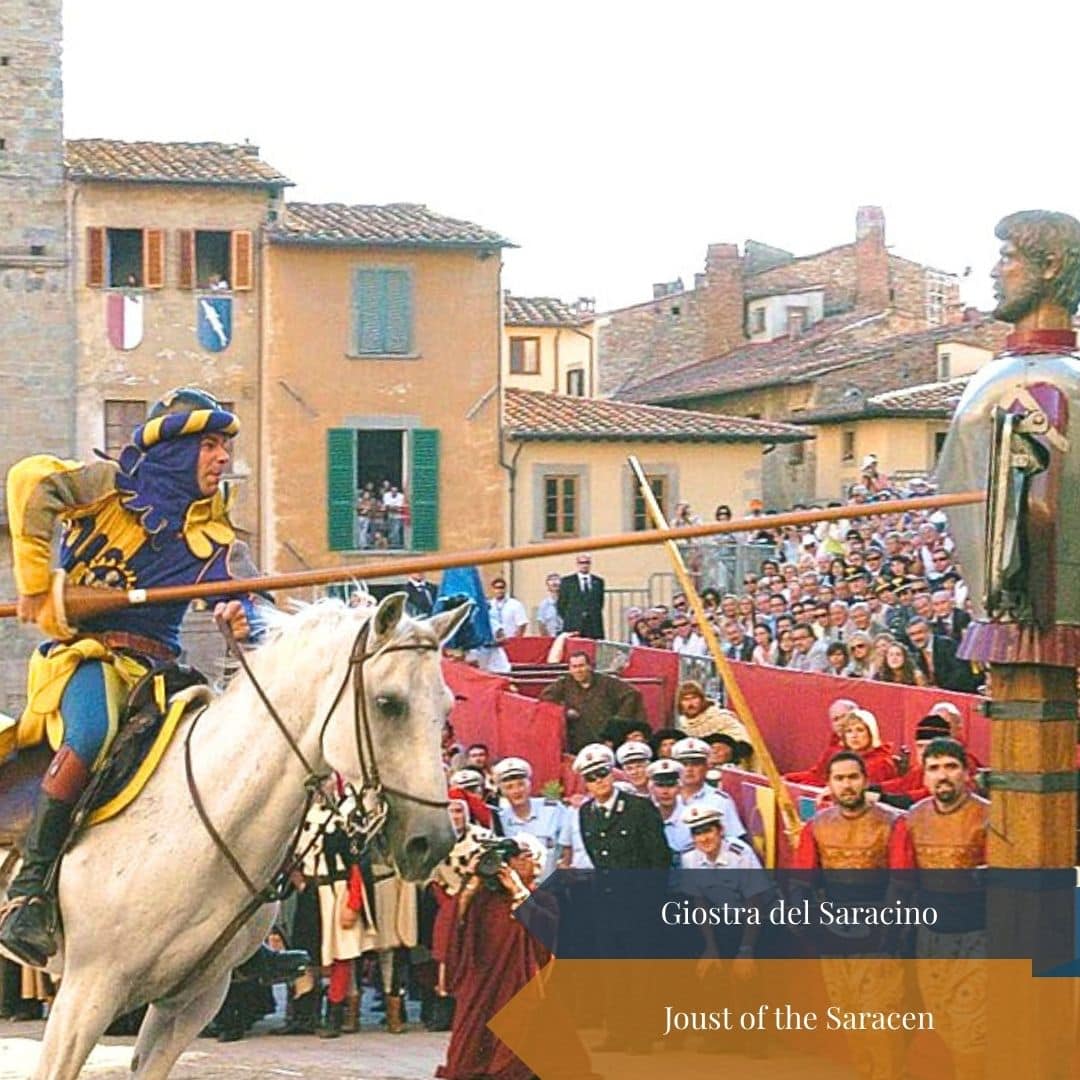
Curiosities: This is precisely where the Giostra del Saracino is held (in June and September), which we will discuss in detail later. Additionally, this square served as the primary set for many scenes in the movie “Life is Beautiful.”
Church of Santa Maria della Pieve:
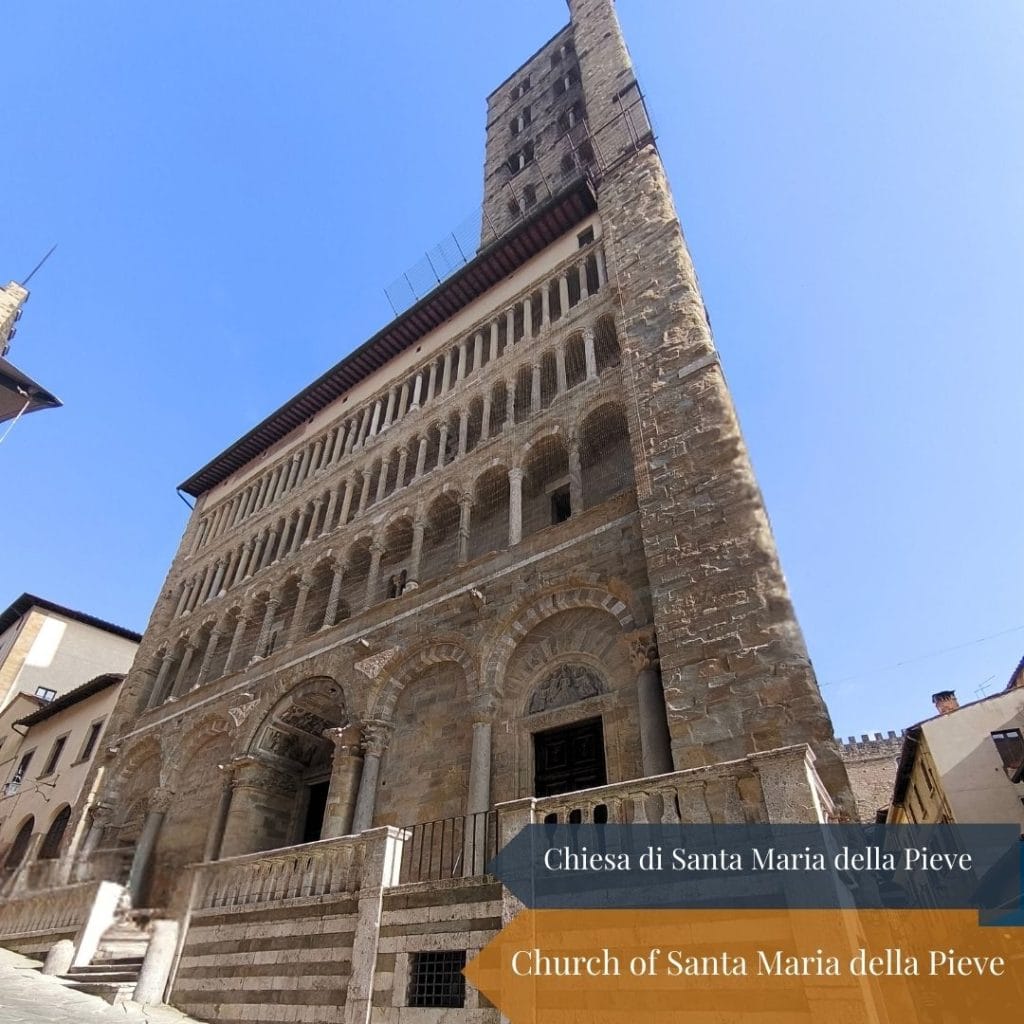
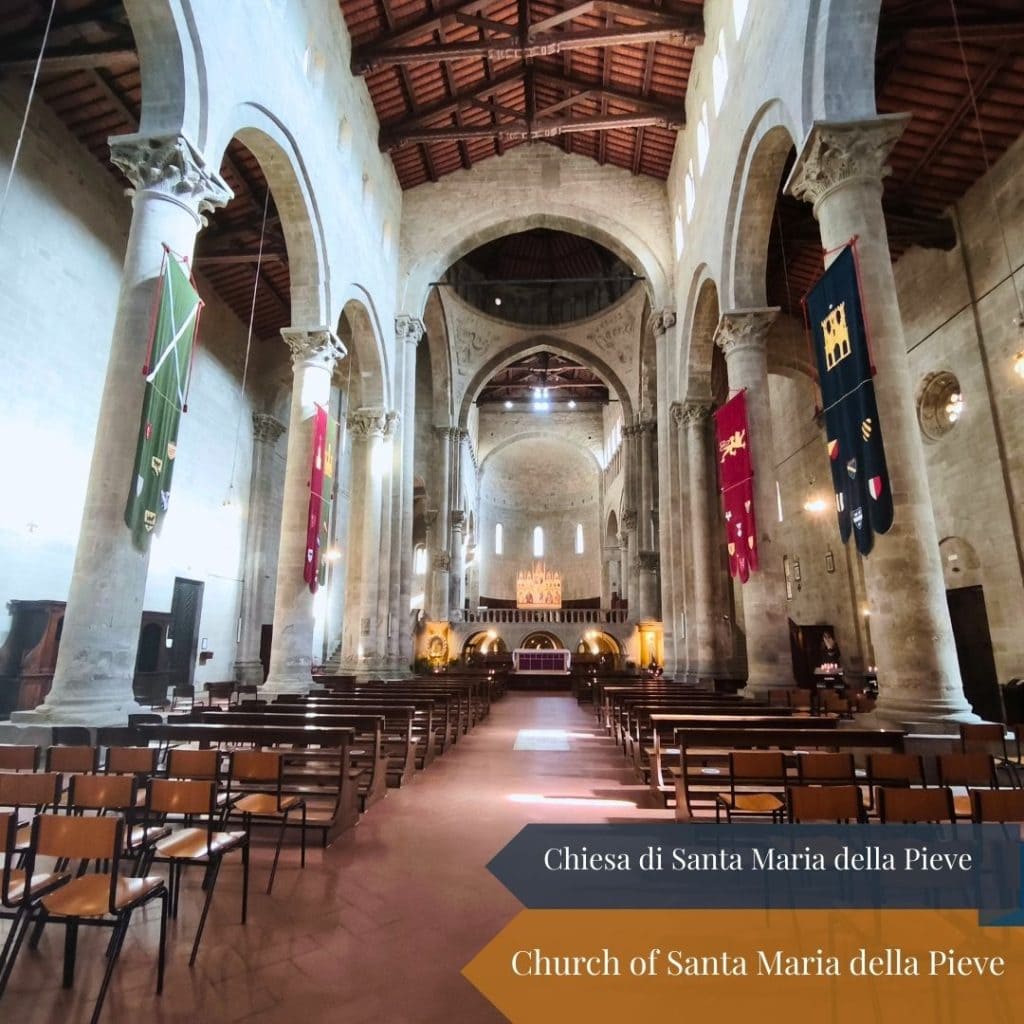
Located along Corso Italia, it is famous for its “loggia-style” façade. Its architectural style blends Romanesque and Gothic elements, and it was likely built on the site of an ancient temple dedicated to the god Mercury (patron of commerce, wealth, travelers, and communications).
Construction began so long ago that it dates back to the 5th century AD, when the Christian religion was still in its infancy. It stands where it is said the last miracle of Saint Donatus took place.
The parish church is first mentioned in official documents shortly after the year 1000 and would continue to undergo changes for the next two hundred years.
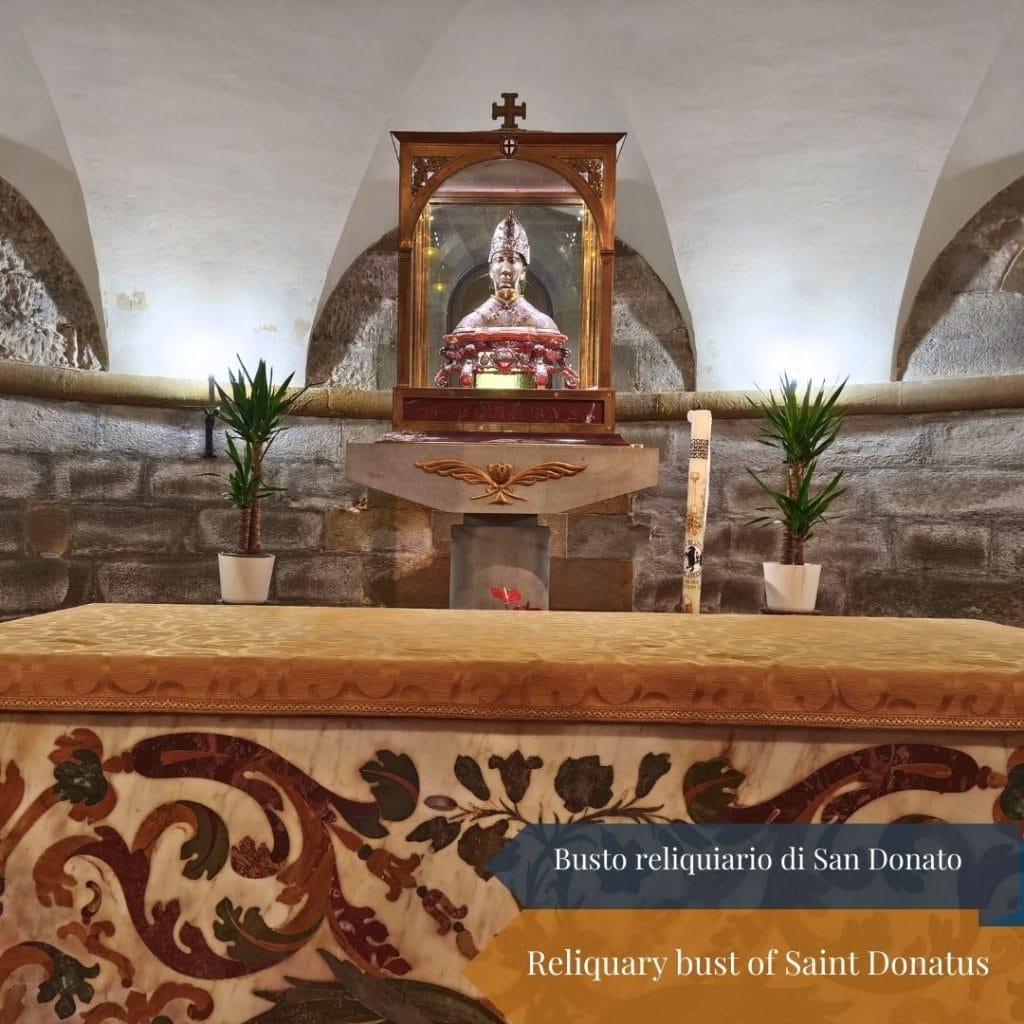
The crypt of the church houses the reliquary bust of Saint Donatus, Bishop of Arezzo and patron saint of the city, which was discovered in the mid-1800s.
Fun fact: It is called the “Church of the Hundred Holes” because of the numerous single-lancet windows that adorn the imposing bell tower.
The Cathedral (Cathedral of San Donato):
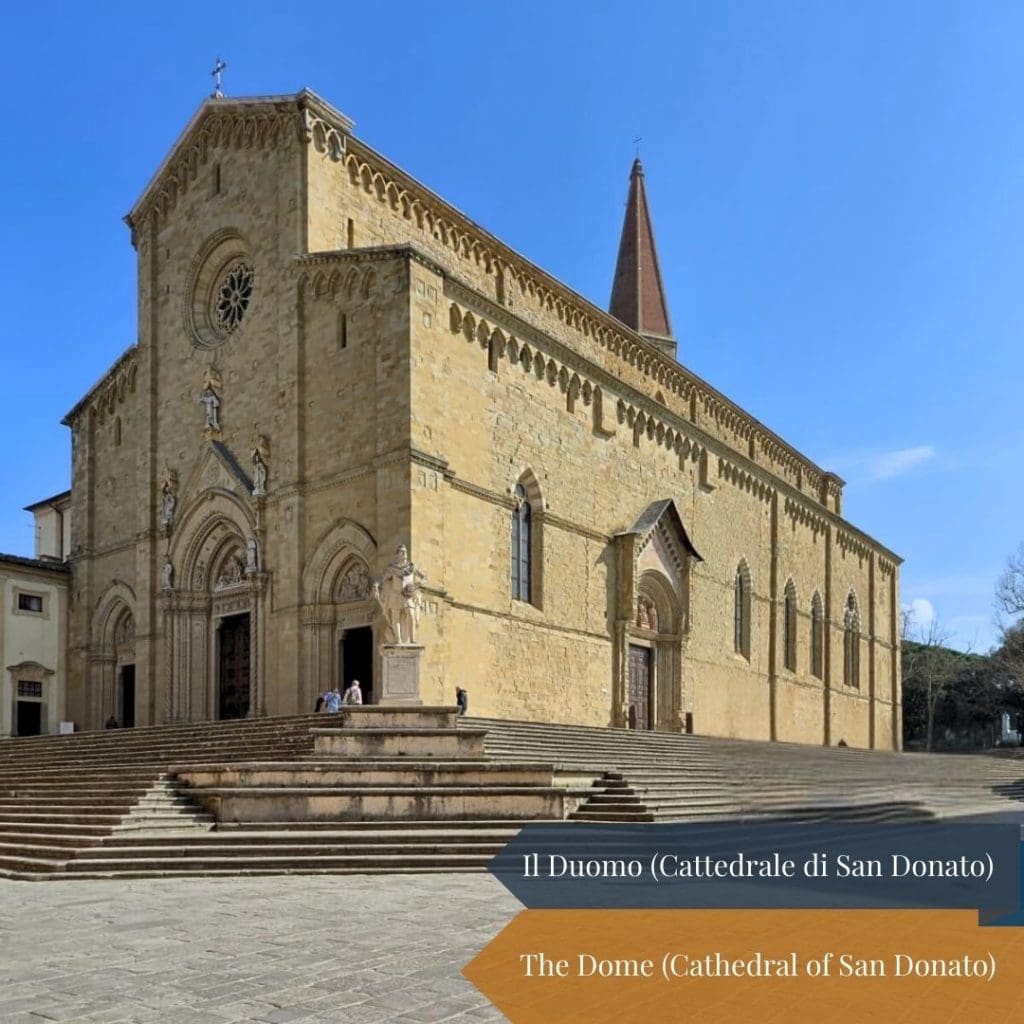
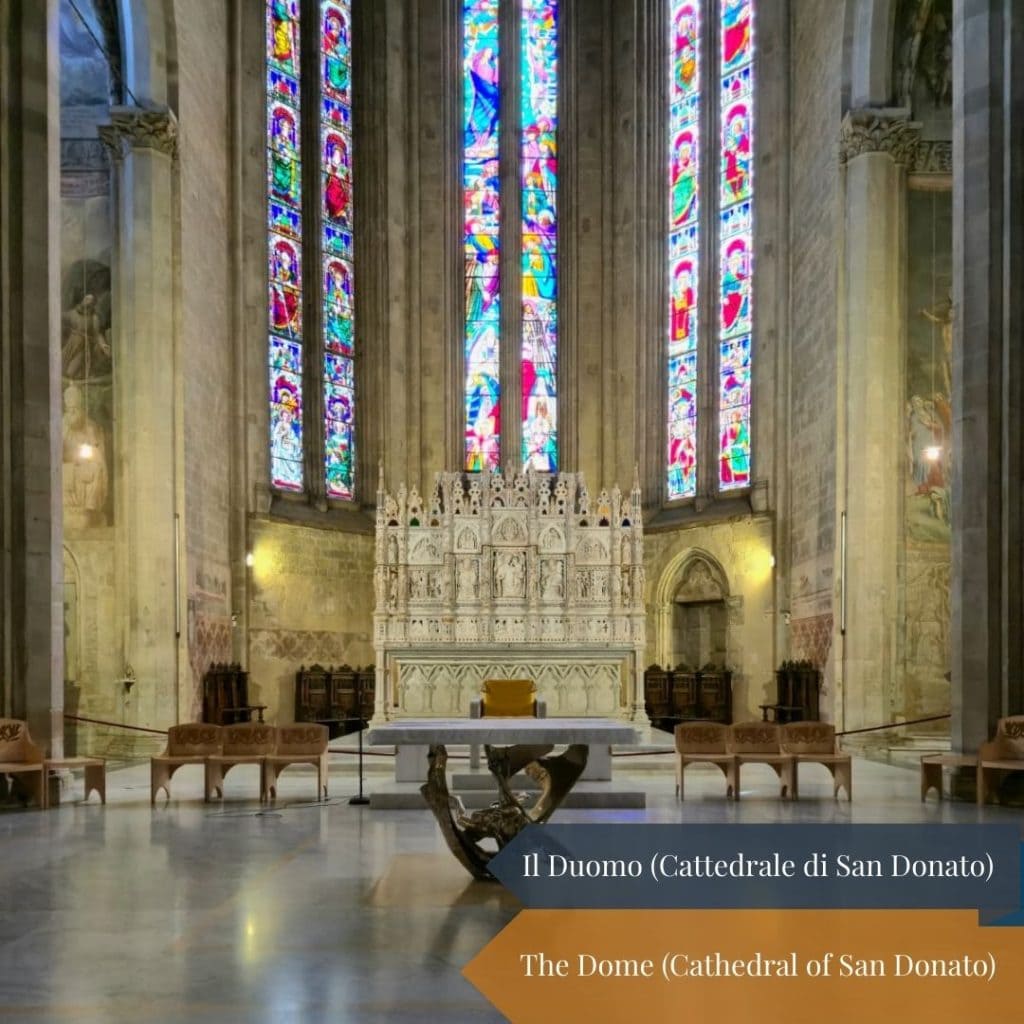
Located at the top of the hill, it dominates the city. The Cathedral of Saints Peter and Donatus, the Duomo of Arezzo, is the spiritual symbol of the city and stands imposing at the summit of San Pietro hill. Unlike many other Tuscan cathedrals that impress with polychrome facades and elaborate marbles, the Duomo of Arezzo presents itself with an austere and solemn bulk, almost like a fortress of faith overlooking the surrounding town.
Construction began in 1278, but the works dragged on for centuries, undergoing numerous interruptions due to the city’s acquisition by the Lordship of Florence. For centuries, the Duomo remained without a real facade, showing only bare brick. The one we admire today, in Neo-Gothic style, was only built at the beginning of the 20th century (between 1901 and 1914), attempting to respect the medieval style of the rest of the building.
The current bell tower is the third in the Duomo’s history. The previous ones had to be demolished or collapsed due to the presence of underground aquifers that made the ground unstable. The current bell tower, with its characteristic spire, has become one of the city’s most iconic profiles.
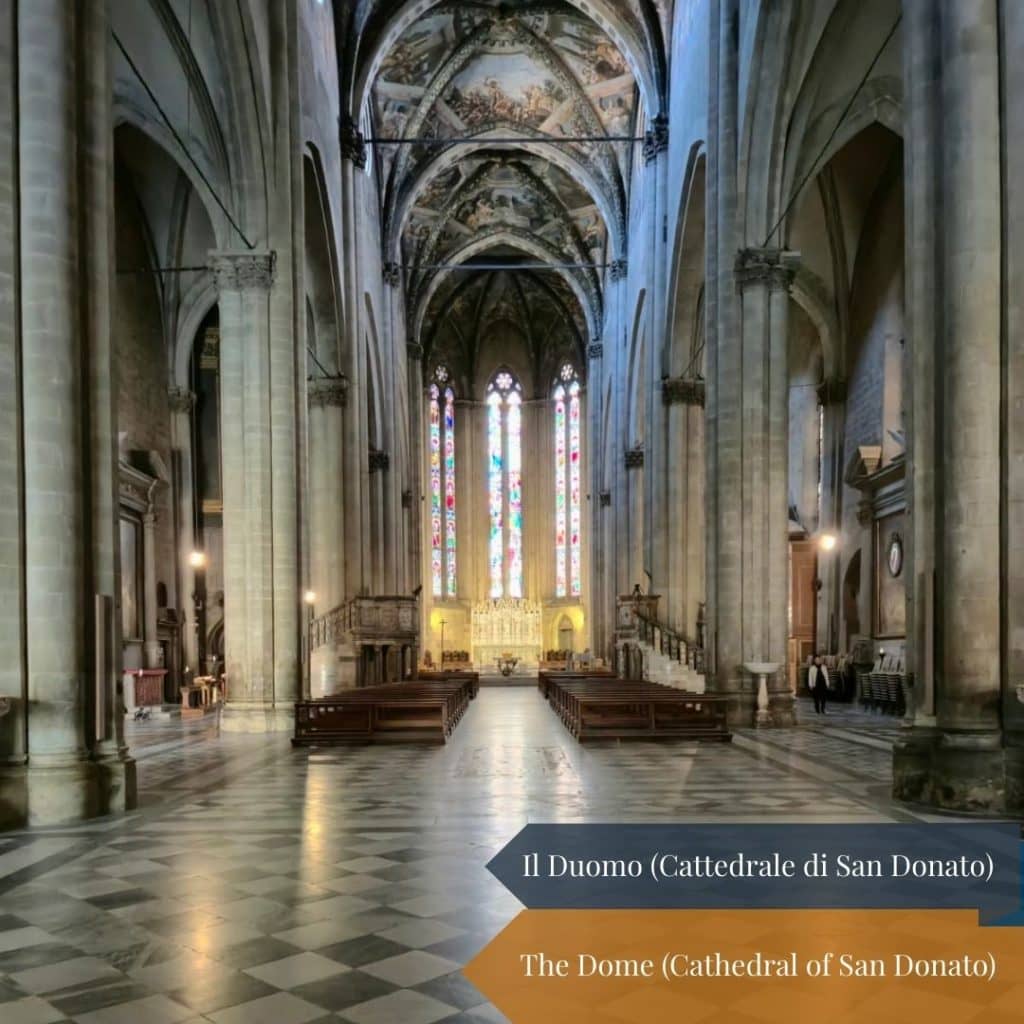
While the exterior is austere, the interior is an explosion of art and spirituality:
- The Stained Glass Windows by Guillaume de Marcillat: These are considered among the most beautiful in the world. Created in the early 16th century, these windows are true “paintings of light” that narrate biblical stories with an incredible chromatic range. The light filtering through these windows at sunset creates a magical atmosphere in the aisles.
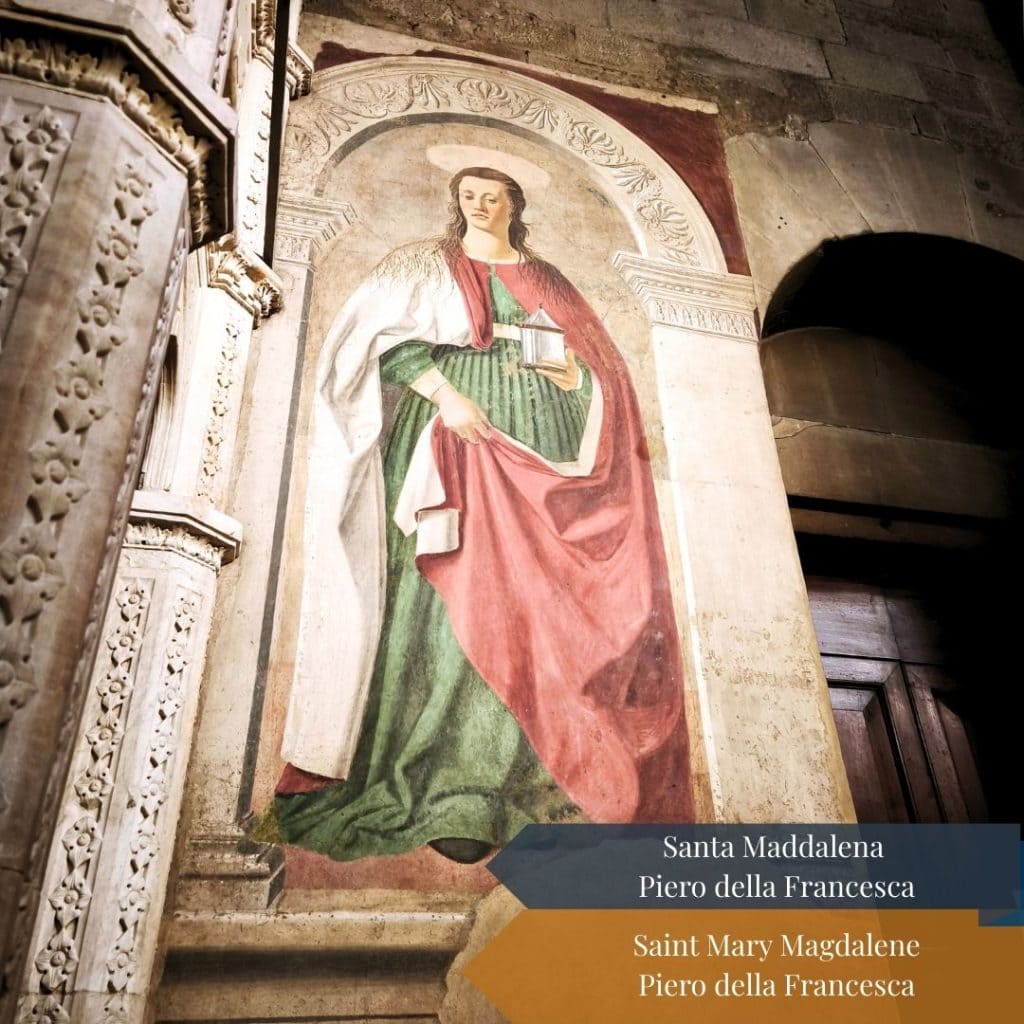
- Piero della Francesca’s “Magdalene”: Next to the sacristy door is a small but powerful fresco. Piero’s Mary Magdalene is a monumental figure, solid as a statue, wrapped in a bright red cloak with an absorbed gaze. It is a perfect example of his mastery of light and geometry, which is especially evident in the vessel she holds in her hand.
- The Ark of Saint Donatus: Shining at the center of the apse is the Ark of Saint Donatus, a monumental 14th-century marble sarcophagus, finely sculpted, which houses the relics of the city’s patron saint, martyred right here in Arezzo.
Curiosities:
- In front of the Duomo stands the Palazzo del Comune (Town Hall), on whose walls are plaques commemorating the names of all the city’s podestà (chief magistrates).
- A side chapel houses the image of the Madonna del Conforto, a small glazed terracotta portrait. Legend has it that in 1796, while the city was shaken by continuous earthquakes, the image miraculously lit up and the tremors ceased. Since then, she has been the protector of the people of Arezzo, and the September Giostra del Saracino is dedicated to her.
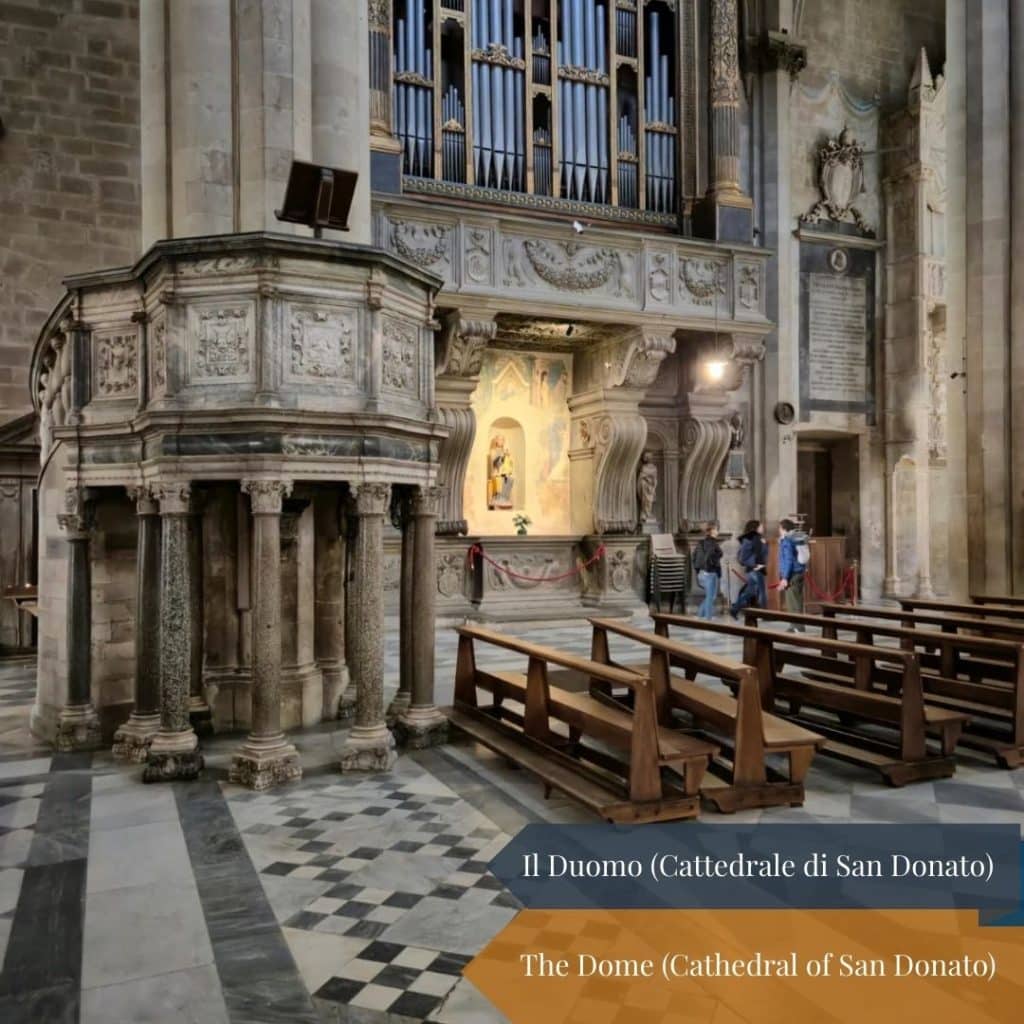
- The Duomo houses one of the most important pipe organs in the region, often the centerpiece of concerts that take advantage of the exceptional acoustics of the three high aisles.
Vasari's home:
The Saracino Joust:
🍴What to eat whilst in Arezzo
Here is the English translation for the dining and food section, formatted with HTML tags:
To conclude your day in Arezzo on a high note, we suggest two unmissable gastronomic stops, both characterized by refined decor and impeccable service.
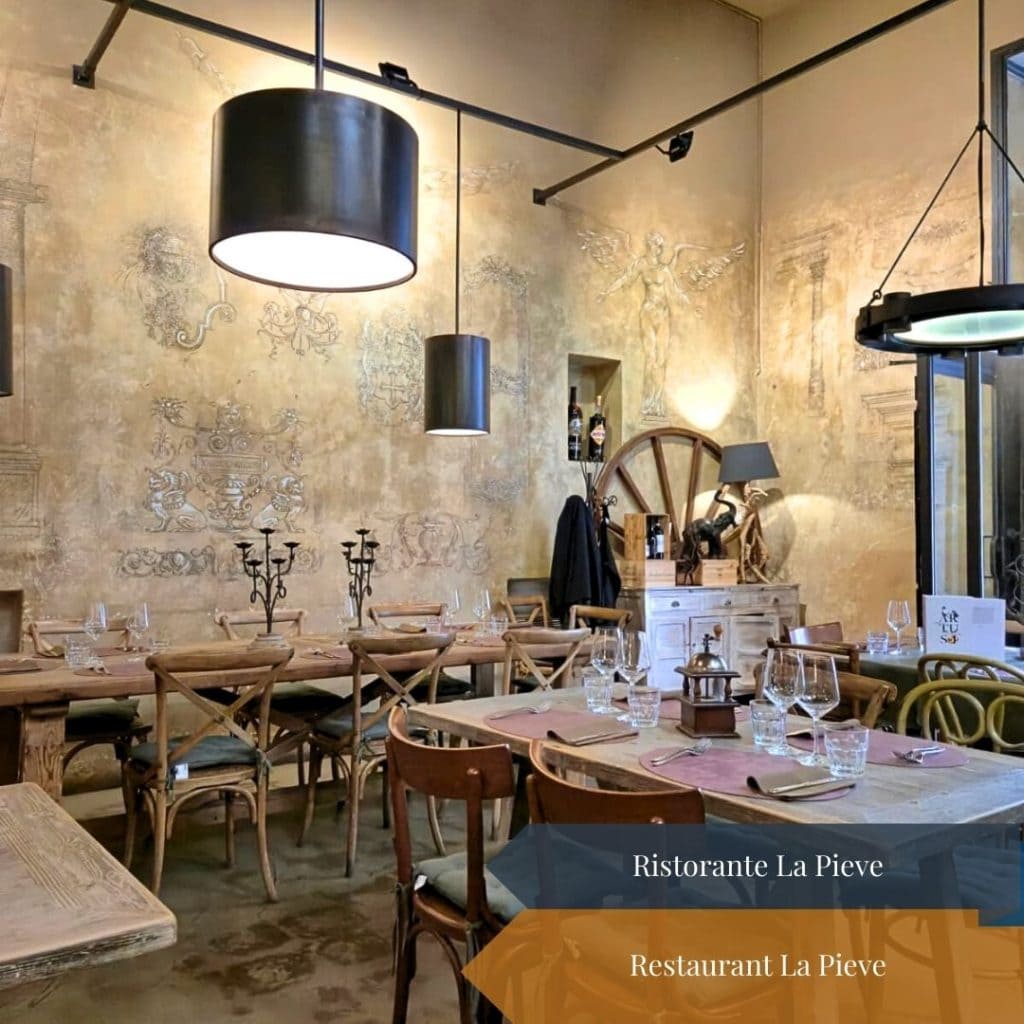
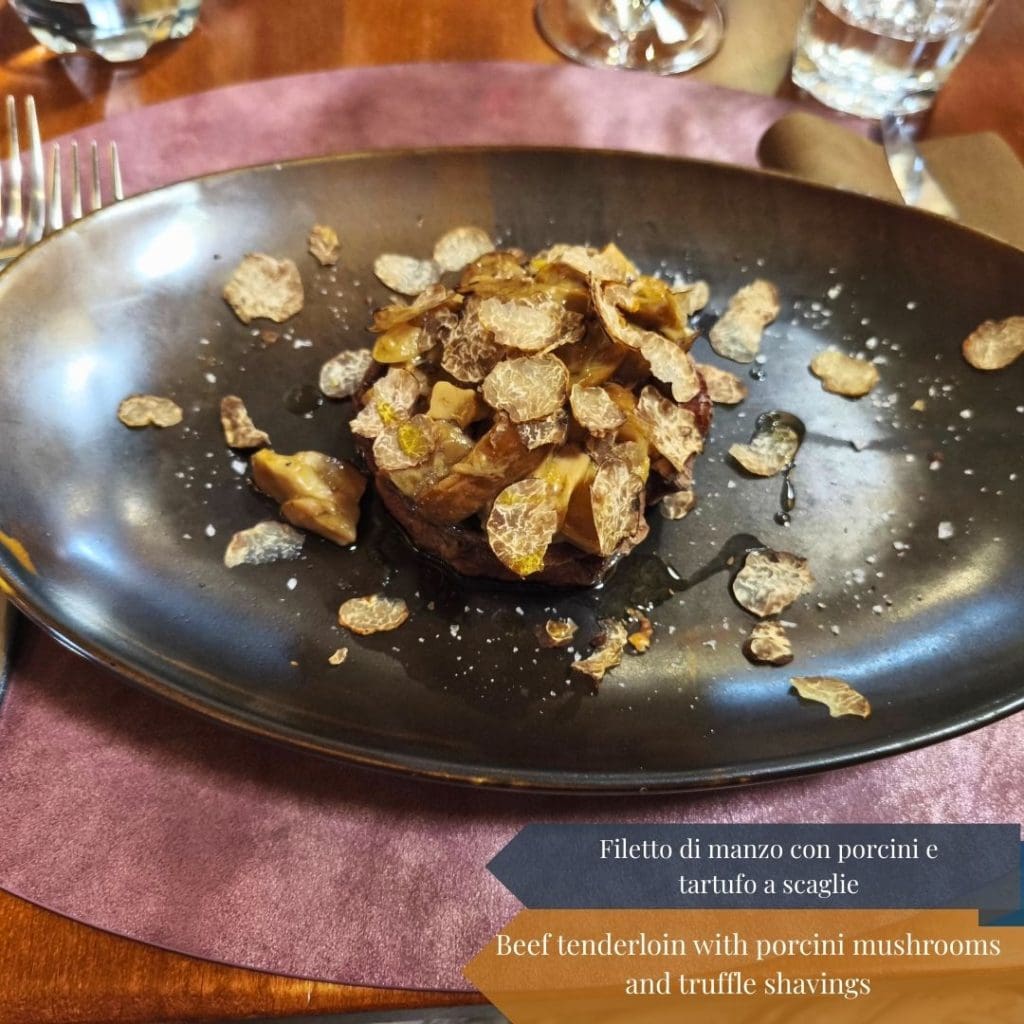
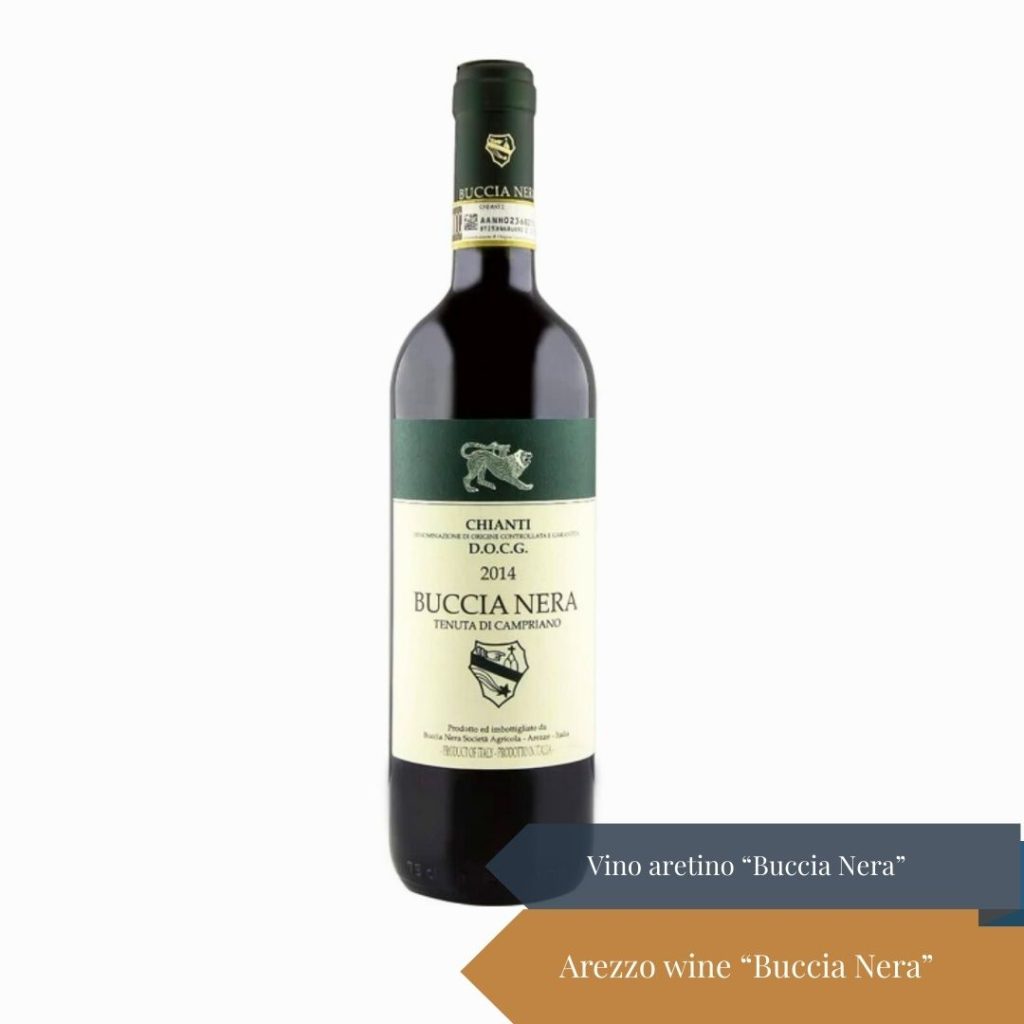
For lunch, the ideal choice is Ristorante La Pieve (Via di Seteria, 7), located just a step away from Piazza Grande. This place literally won us over: you cannot miss the beef fillet with truffle and porcini mushrooms—a dish with a remarkable and enveloping flavor—accompanied by classic fagioli all’uccelletto (cannellini beans in tomato and sage) and a glass of Buccia Nera, a typical young Aretine wine that pairs divinely with the meat.
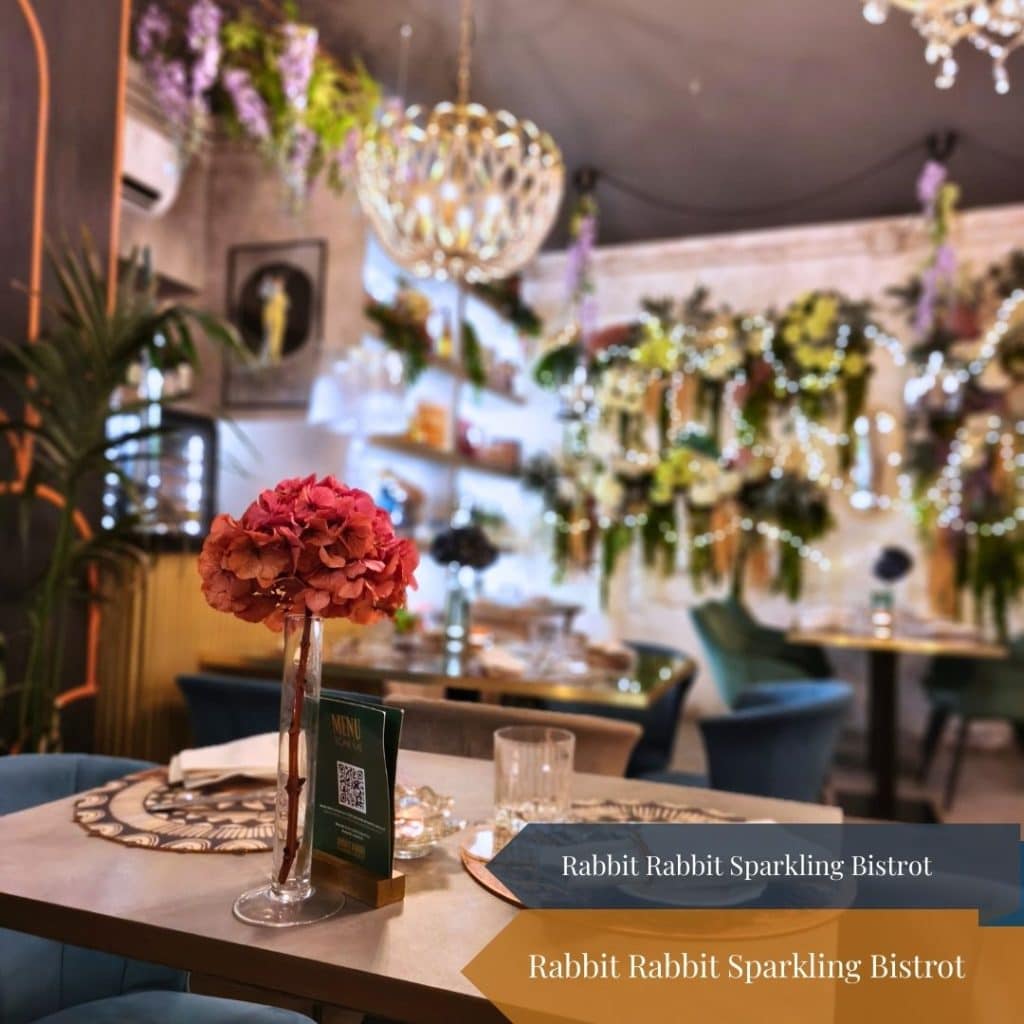
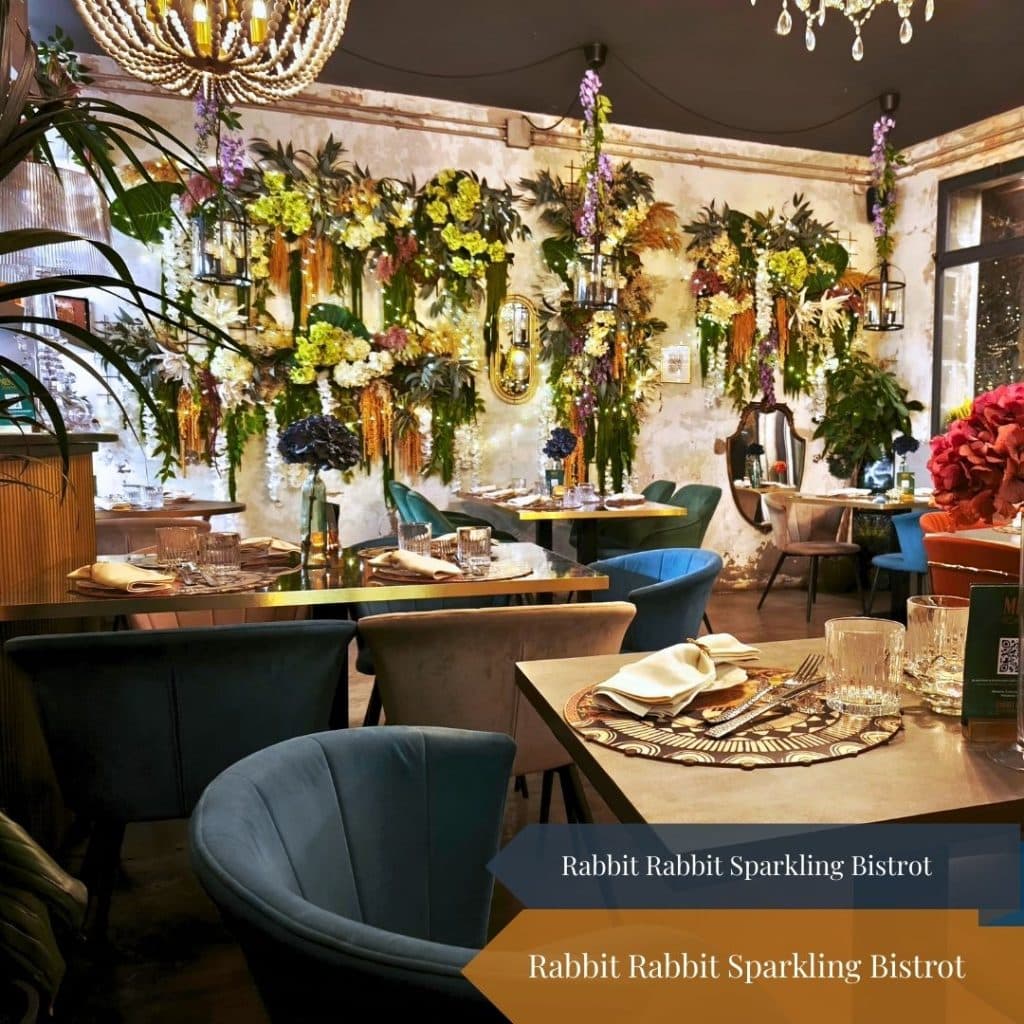
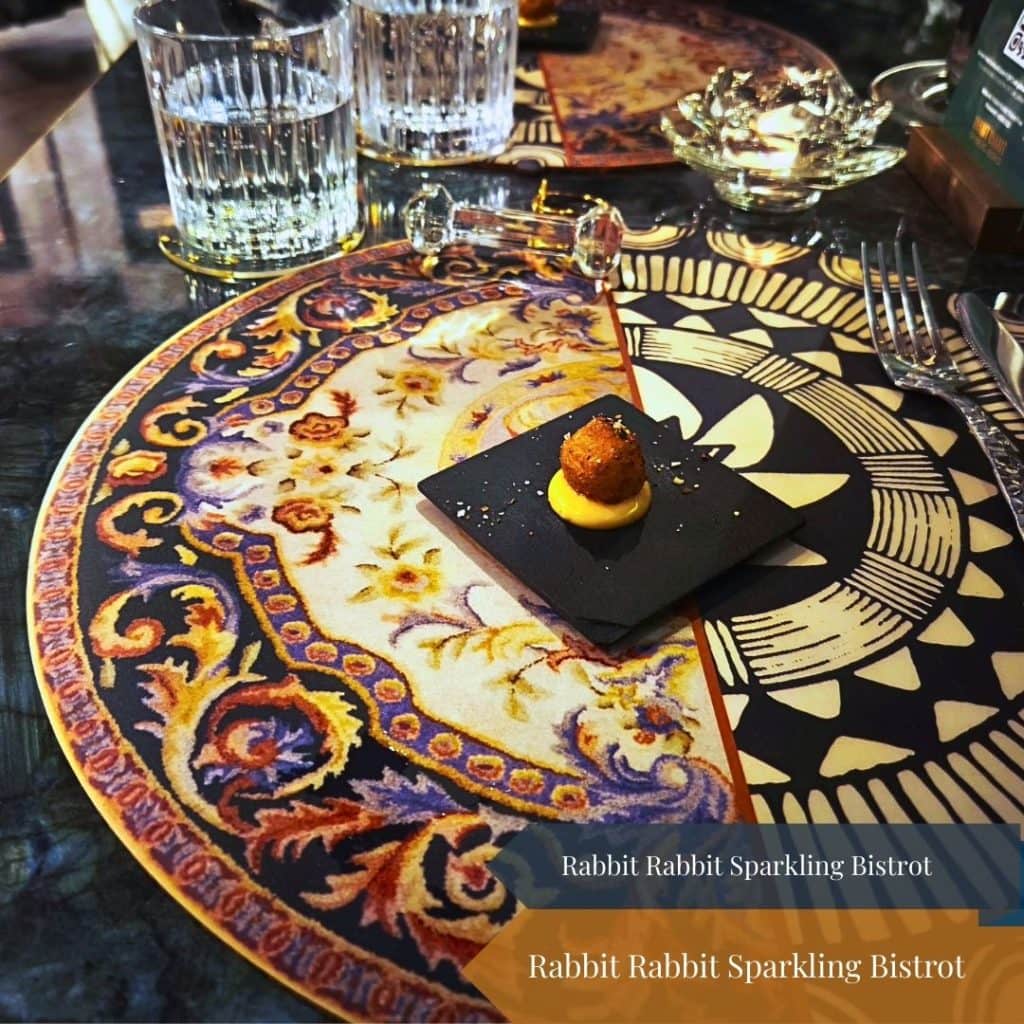
After continuing your tour through the city center streets, and before heading back to Florence, the perfect stop is Rabbit Rabbit (Corso Italia, 122). Here, a sophisticated atmosphere and modern design set the stage for an excellent selection of tapas and quality wines—the ideal spot for a rejuvenating aperitivo to end your tour along the city’s main thoroughfare in perfect style.
Other dishes you shouldn’t miss:
- Crostini Neri: Similar to the Florentine ones but with a slightly different recipe, often featuring spleen and chicken livers, served on unsalted Tuscan bread.
- Pappardelle all’Ocio: The “ocio” is the male goose. Goose ragù is the traditional condiment of an Aretine Sunday lunch.
- Chianina Steak: You are very close to the Val di Chiana, the homeland of Italy’s most prized cattle breed.
- Gattò Aretino: A dessert in the shape of a sponge cake roll soaked in Alchermes liqueur and filled with custard and chocolate. A true sugar explosion!
What are you waiting for? Come explore Arezzo!
Book your stay in Florence and treat yourself to this trip!